

In this article
- GS1 Digital Link and "Sunrise 2027": what changes
- What is GS1 Digital Link?
- Consumers want transparency (and are willing to pay for it)
- The solution: connected, digital packaging
- How Merqrio makes your packaging smarter
- Why 2027 is already just around the corner
- Ready to make your packaging an unlimited, sustainable space?
- FAQ – GS1 Digital Link and sustainable packaging
The traditional linear barcode (EAN/UPC) has played its part, but global retail is preparing for an announced transition: by 2027, 2D codes based on the GS1 Digital Link standard will become a new reference for point-of-sale scanning and digital communication with consumers.
For consumer goods brands, this is more than a technical evolution: it is an opportunity to turn every package into a direct channel that is richer in information and more sustainable.
GS1 Digital Link and "Sunrise 2027": what changes
GS1 Sunrise 2027 is the global initiative encouraging retailers and brands to adopt 2D barcodes (mainly GS1-compliant QR codes and Data Matrix codes) for point-of-sale scanning by the end of 2027.
This does not mean that old barcodes will automatically "disappear" on 1 January 2028. It means that a transition is underway:
- retailers expect to be able to scan 2D codes at the POS on all products
- brands should already have started migrating to 2D codes that comply with GS1 standards
What is GS1 Digital Link?
GS1 Digital Link is a global standard that:
- Transforms GS1 identifiers (GTIN, GLN, batch numbers, expiry dates, serial numbers and so on) into a structured URL.
- Allows the same 2D code to be used both for point-of-sale scanning (like a regular barcode) and to open, via smartphone, a page containing product information such as traceability, ingredients, nutritional values, instructions and sustainability details.
In practice, a single 2D code becomes the product's "digital passport", connecting the physical object to its digital twin and enabling B2B and B2C use cases.
Consumers want transparency (and are willing to pay for it)
Today, customers want to know what they are buying, how it is produced and, where possible, what impact it has on the planet.
Various international studies show that a majority of consumers consider sustainability when making everyday purchasing decisions. A significant share is also willing to pay a premium for products that are more environmentally friendly and transparent. In food in particular, transparency about origin, ingredients and nutritional information is increasingly a deciding factor.
The practical problem is that space on labels and packaging is limited. How can you explain the supply chain, ingredients, certifications, recycling and disposal instructions in a small space without multiplying paper inserts, leaflets and booklets?
The solution: connected, digital packaging
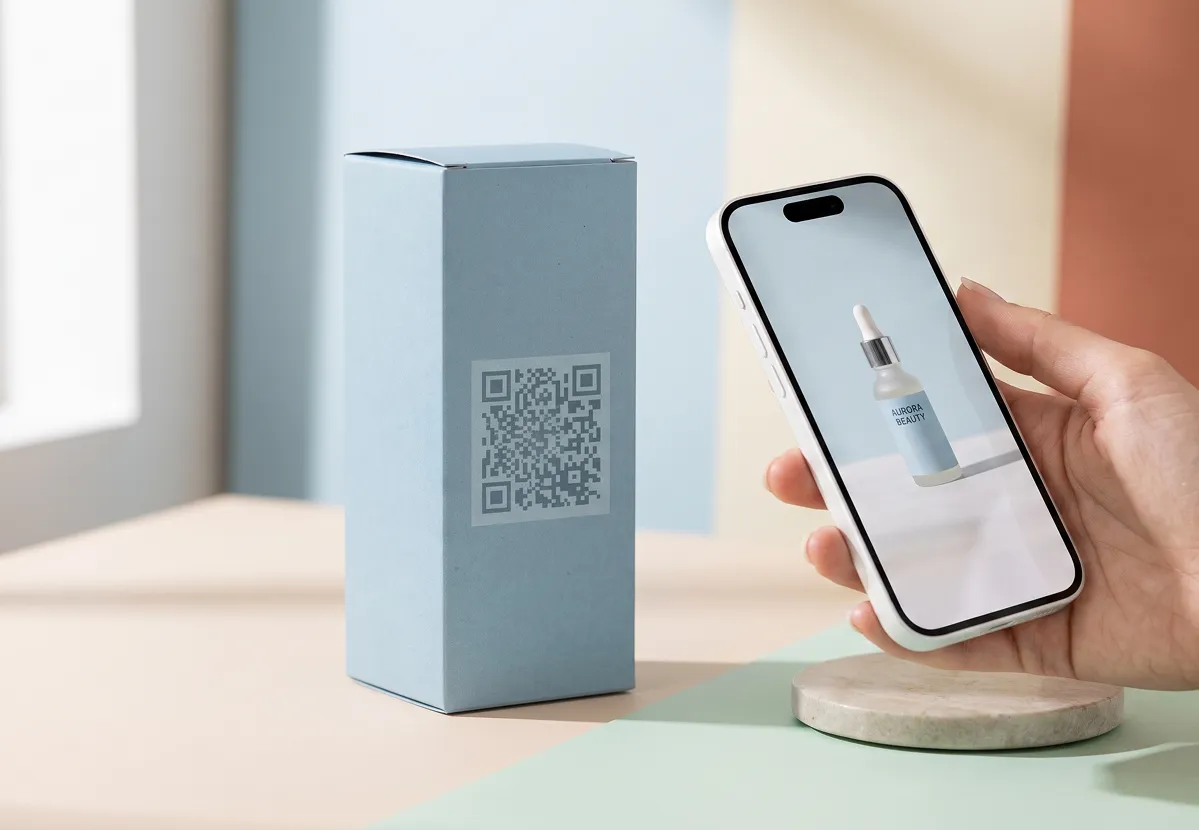
QR codes and usage habits
QR codes are now part of everyday life. Industry reports from 2025–2026 highlight that:
- a growing share of consumers regularly use QR codes to access product information, instructions and branded content
- familiarity with QR codes increased further after the pandemic and with the spread of digital payments and ticketing.
Replacing some paper inserts with a dynamic QR code allows you to:
- move lengthy information to a digital channel
- update content without reprinting packaging
- reduce print volumes, paper consumption and CO₂ emissions
Major brands in fashion, electronics, food and consumer goods have already reported significant paper reductions by removing or greatly reducing instruction booklets, technical sheets and inserts in favour of 2D codes.
How Merqrio makes your packaging smarter
With Merqrio, the move to connected packaging is smooth, standards-compliant and measurable. Here are the main benefits.
No waste when regulations or marketing change
- Have the rules on ingredients, allergens or recycling instructions changed?
- Want to launch a new campaign, competition or update a claim?
With a dynamic QR code managed by Merqrio:
- you update the link's destination from the dashboard
- the code printed on the packaging stays the same
- there is no need to discard and reprint stock that has already been produced.
Geolocation and advanced analytics
As well as informing customers, packaging becomes a source of data:
- each scan can return anonymous information about country, region, city, time, device and source channel
- brands can understand where packages are scanned most often, which campaigns work best, and how products move through the supply chain and retail.
With Merqrio, you can access this data in real time to make better-informed decisions about marketing, distribution and product ranges.
Branded domains and trust
Trust is crucial: consumers need to feel safe scanning a code.
With Merqrio you can use branded domains (such as info.yourbrand.com or go.yourbrand.com) within the QR code, make the link immediately recognisable and consistent with your identity, reduce the perceived risk ("where will this QR code take me?") and increase scan rates.
From packaging to conversion: landing pages and contact forms
Beyond making packaging informative and sustainable, Merqrio lets you turn every scan into a business opportunity. From the dashboard you can create landing pages dedicated to conversion, complete with contact forms to collect information requests, demo requests, programme registrations or qualified leads. This way, the QR code does more than direct consumers to a product page: it becomes the first step of a funnel that can be measured and optimised over time.
Why 2027 is already just around the corner
The timeline is clear:
- Now – 2025/2026: experimentation and initial pilot projects, particularly among major retailers and global brands.
- 2026–2027: migration to GS1-compliant 2D codes accelerates, with retailers beginning to explicitly request 2D codes for new products.
- End of 2027: the Sunrise 2027 horizon, with the global retail industry moving towards 2D scanning at the point of sale.
Waiting until the last moment carries real risks:
- having to reprint millions of labels within tight deadlines
- losing years of data about how consumers interact with packaging
- falling behind competitors that already use packaging as a measurable digital channel.
Ready to make your packaging an unlimited, sustainable space?
2027 is not a distant possibility: it is an operational horizon already shaping retailer and brand decisions. Turning packaging into a digital channel means communicating more, communicating better and keeping information current, reducing paper and environmental impacts, and gaining valuable data on consumption and behaviour.
Digitise your packaging with Merqrio
Create your first trackable QR code in minutes. No credit card required.
Start for free
